
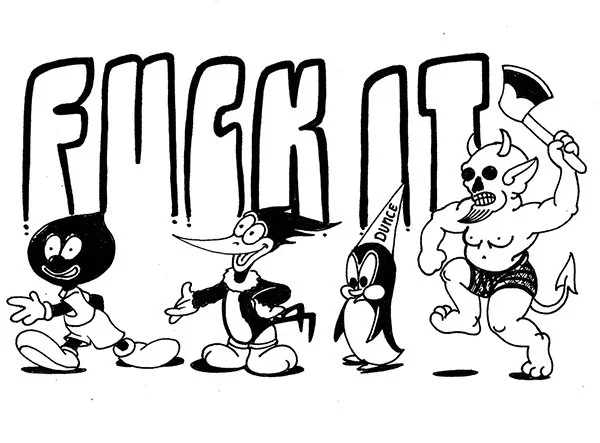
Fuck It! Illustration Courtesy of Jeffery Page
ENJOY!
VANDALS LIST
If you need a homemade recipe to create eye-catching, long-lasting marks of vandalism, graffiti, or street art. Here is some help. It is essential to use the right materials. Even if this isn't the right one. It's a start. So fuck it up and take this list and make a mark. Love Jeffery Page & Friends
Spray paint: High-quality spray paint is crucial for vibrant, long-lasting artwork. Brands like MOLOTOW, MONTANA, & IRONLAK offer a wide range of colours and finishes to suit any artist's needs.
Markers: Permanent markers and paint markers, such as POSCA or KRINK are perfect for adding detail and outlining your work. Other stuff can be found on AMAZON.com a few of Jeffery Page & Friends also love Sakura Solid Markers.
Sketchbook: A sketchbook is an essential tool for planning and refining your designs before committing them to a larger surface. You should also explore different styles to truly find your own.
Gloves: Protect your hands from paint and chemicals with a pair of disposable gloves. Better gloves also help for Cold environments and dealing with fucked up surfaces.
Mask: A respirator mask is a must for protecting yourself from harmful fumes and particles while spray painting. Although we know why painting is so much fun. Stay huffing.
Caps: Different spray caps allow for varying levels of control and spray width, allowing you to achieve different effects in your artwork. Although Cueball says,”The art is vandalism. Just leave a mark.”
History of Graffiti
Graffiti has a rich history that dates back to ancient civilizations. From Egyptian hieroglyphics to Roman inscriptions, graffiti has long been a means of expressing oneself and communicating with others.
Ancient Graffiti
Historical examples of graffiti can be found in various ancient cultures, such as Egypt, Greece, and Rome. These early forms of graffiti were typically etched or painted on walls, monuments, and other public surfaces, and often served as a means of expressing political dissent or personal declarations of love and admiration.
Modern Graffiti
The modern era of graffiti began in the 1960s and 1970s, with the rise of street art in New York City. This new form of expression was characterized by bold, colorful designs and messages that reflected the artists' experiences and surroundings. As the popularity of graffiti grew, so did its impact on society, with graffiti becoming a prominent feature in music, fashion, and other forms of popular culture.
Mastering Graffiti Techniques
Graffiti techniques vary depending on the materials used and the desired effect. Below are some essential techniques to help you elevate your graffiti game:
Can Control
Can control is the foundation of graffiti art. It involves mastering the use of spray paint, controlling the pressure, and adjusting the distance from the surface to achieve consistent lines, fades, and effects.
Outlining and Fill-ins
Outlining involves creating the basic structure of your design, while fill-ins involve adding color and detail to the outlined areas. Mastering these two techniques is essential for creating clean, professional-looking graffiti.
Shading and Highlights
Shading and highlights add depth and dimension to your artwork. To master shading, practice blending colors and creating gradients with spray paint. For highlights, use lighter colors or even white to accentuate certain areas of your design.
Drips and Splatters
Drips and splatters are popular techniques that can add an edgy, spontaneous feel to your graffiti. To create drips, apply extra paint to an area and allow it to run down the surface. For splatters, flick your wrist while holding a paint-filled marker or spray paint can to achieve a scattered effect.
Graffiti Terminology
Understanding graffiti terminology will help you better communicate with fellow artists and appreciate the nuances of the art form. Here are some common terms to familiarize yourself with:
TAG - A stylized signature or name used by graffiti artists
THROW UP - A quickly painted piece, often composed of bubble-style letters and a simple color scheme.
PIECE - A more elaborate and detailed graffiti work, often incorporating intricate lettering and designs.
BOMBING - The act of covering a large area with graffiti in a short amount of time.
STENCILING - A pre-cut template used to create consistent shapes and designs in graffiti art.
WILDSTYLE - complex, interlocking lettering style characterized by its intricate, overlapping elements.
Graffiti Ethics and Legalities
Graffiti is a controversial art form, often associated with vandalism and property damage. It's important for artists to understand the legal and ethical implications of their work. Here are some considerations:
Respect private property: Avoid painting on homes, businesses, or other private property without permission.
Be aware of local laws: Graffiti is illegal in many areas, and penalties can range from fines to imprisonment. Familiarize yourself with local laws before engaging in graffiti art.
Engage in legal graffiti: Many cities have designated legal graffiti zones or host graffiti events, providing a safe space for artists to create and showcase their work.
Conclusion
Graffiti is a vibrant, expressive art form with a rich history and a wide range of techniques, styles, and materials. By mastering these skills and understanding the legal and ethical aspects of the art form, you can create powerful, memorable works that resonate with viewers and fellow artists alike.
ink and paint recipes that you can load into your mops and markers.
ghetto krink ghetto junobo (my favorite)
1/3paint thinner 2/3paint thinner
2/3crome oil based paint 1/3white oil based paint
a cap full of dot3 *optional 200ml of oil based tube paint(the artist stuff you get from ac moore,michaels,dick blick,ect. 200ml is a whole large tube btw)
cheap outdoor ink1 simple ink(by rogue):
1/3paint thinner Mix 3/4 woodstain
2/3wood stain 3 drops dot 3 or fish oil capsules
a couple fish oil tablets 1/4 Good Shoepolish (not Kiwi)
GHETTO DED GHETTO H2B
1 bottle Fiebings Purple 1/3BLACK ACRYLIC PAINT
1 bottle of Purple PVC Primer 2/3BLACK RIT DYE
Gentian Violet 3 DROPS OF DOT3
3 Fish Oil tablets
And some Solvent Violet 8 NOTE:ADD CHARCOAL POWDER IF YOUR H2B IS TO THIN
Fumers Patanted Ink!! Black Ghetto Garvey
3 pen inks (preferably black and red) Charcoal
300ml of methylated spirits Alchohol
two splashes of any pertinent ink (corio,pilot,nero,grog) Black Pens
carbon paper dust Mixing container & coffee filter
directions;
mix all together in a bottle or jar and let it all sit for a day or two
and depending on how much carbon dust you add its fairly opaque.
Directions
-Go get some charcoal, REAL charcoal, preferably willow. Pinecones work too. Do not use BBQ charcoal, as it's mixed with sand, your best option is to make it yourself, or go down to the beach, there's usually some driftwood with a thick layer of charcoal.
-Next you're going to need to break the charcoal into small pieces and grind it up, a coffee grinder works well. Make sure it's a fine powder, use a pestle and mortar if you have to. (Pestle and motor is a bowl and round stick used in cooking certain cultural dishes... Or summoning dragons.)
-Alcohol, the higher percent the better.
-Pour the alcohol into a large container with a sealed lid, add more charcoal than you think you need.
-Shake as much as possible, let it sit for a while (a day if you can) and shake some more.
-Pour through a coffee filter into another container, and back through the filter into the original container. This takes out any insoluble charcoal.
-Test your ink.
-If it's decently opaque break open some black pens and get as much in there as needed, it should be as opaque as india ink. (don't worry it doesn't buff nearly as easy)
-Get some additives in there (fish oil, methylene blue, gentian violate(sp) etc.)
-If it's not very opaque (before the pens) add more powdered charcoal and repeat the previous steps as necessary.
DO NOTS:
DO NOT USE BLEACH
DO NOT MIX INK AND PAINT IT DOESN’T WORK(SEP IF YOUR MIXING WATER BASED PAINT(ACRYLIC PAINT)AND WATER BASED INK)
DO NOT USE RIT DYE THE ONLY THING ITS GOOD FOR IS THINNING WATER BASED PAINT
DO NOT MIX PAINT THINNER WITH WATER BASED PAINT IT JUST MAKES IT THICKER
So make shit. Have Fun. Leave a Mark. Also please send us your recipes.